Programming
Call for proposals 2027-2028
The Art of What Passes Between Us
As part of its three-part call for proposals (performances, critical thinking, and public writing), the DARE-DARE artist-run center is seeking proposals for artistic projects to develop its 2027–2028 program.
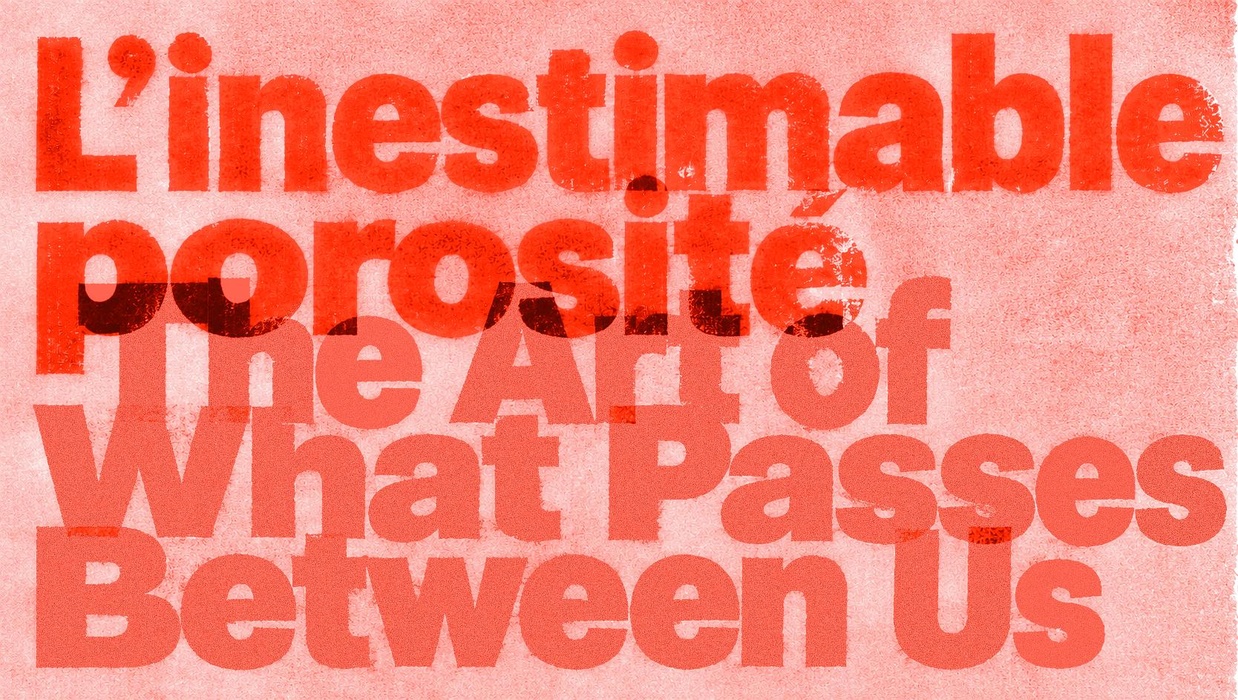
The Art of What Passes Between Us
An invitation shaped by: Khadija Ben Ali, Lucas Ferguson-Sharp, Valérie Gariépy, Vincent Lacasse, Yanick Tanguay and Martin Dufrasne
For its 2027–2028 programme, DARE-DARE seeks to welcome projects that explore what connects us and the many ways of making a world together. We are looking for proposals that unsettle boundaries, open up fissures and passages, carve out spaces of hospitality, and give form to other ways of being in the world. Gestures and situations that make encounters possible, welcome the improbable and the unforeseen, and allow what cannot be anticipated or possessed to come into being.
We are not looking for artworks as answers, but for gestures as openings:
· Gestures that make art an experience of relation, circulation and transformation, in which nothing and no one remains quite unchanged;
· Gestures that embrace the risks of vulnerability, alterity and the unknown, without seeking to contain or resolve what eludes or resists us;
· Gestures of giving, sharing and passing things on, without calculating the value of what circulates or presuming what might come in return;
· Gestures that make room for attentiveness, trust, hospitality and forms of solidarity that sometimes take shape quietly, almost imperceptibly;
· Gestures that open up possibilities, sketch out ways of being together, and care for what connects us, however fragile or unseen.
Reflections: What connects us, what exceeds us, what remains
Everything is accelerating. Machines produce images, voices, texts, even simulacra of presence; endless growth and the blind pursuit of progress demand that everything be measured, optimized, exploited and monetized: our territories, natural resources, even our relationships. Never have we been so capable of transforming the world and rarely have we been so uncertain about what is worth transforming. What, then, remains of what makes us human: intuition, lived experience, empathy, the pursuit of dignity, freedom and meaning?
We propose porosity as a way of being in the world: the quality of membranes, skins and boundaries that allow themselves to be crossed. Thresholds, liminal zones, off-screen spaces, passages. Identities that are not fixed, reciprocal influences, forms of cross-pollination that elude borders and classifications. To be porous is to embrace complexity and to accept that encounters can shape who we are... It also means relearning that efficiency has little interest in cultivating our capacity for: wonder, contemplation, patience, trust, an openness to vulnerability — our own and that of other living beings. These are not things to be accumulated or optimized. They are practised together.
Hence our interest in the act of giving, of offering, of letting go without any guarantee of return; in sharing, the commons and alternative economies, in opposition to ownership and the market; in restitution and dispossession, in inhabiting a territory without possessing it; in the invisible, ritual and the sacred.
Can artistic creation give rise to forms of resistance that do more than denounce — forms that nurture, connect and slow things down? We invite artists to imagine situations as much as artworks: impromptu gatherings, open tables, vigils, walks, assemblies, invented ceremonies, unprogrammed moments in which spontaneity is given room to unfold. Ways of coming together in unlikely contexts that rely neither on spectacular performance nor on self-expression alone, but on attentiveness, presence and the risk of allowing ourselves to be changed by what exceeds us.
The call for projects is divided into three streams:
Interventions, Public Writings, and Critical Thinking.INTERVENTIONS STREAM
► Four projects will be selected for the upcoming programming year (presented between April 2027 and March 2028).
The Interventions stream of The Art of What Passes Between Us open call is intended for artists who wish to bring art into the fabric of everyday life and engage with geographical and social environments through a wide range of approaches, strategies and interventions of varying durations. Projects may take the form of performances, gatherings, encounters, actions, walks, or other forms of intervention.
DARE-DARE offers:
- Support with project coordination, presentation and promotion
- Exhibition and reproduction fees (CARFAC fee schedules): $3,037
- Fee for a talk or public presentation: $563
- Reimbursement of production materials: $1,200
- Assistance in obtaining the necessary permits and authorizations
- Photographic documentation
Submit your proposal in whatever format best suits your practice (written, visual or audio), addressing the following four points:
- A description of your artistic practice
- A description of your project, its anticipated context and its feasibility
- An outline of your support requirements
- Images and/or web links
Only digital submissions will be considered. Total submission size must not exceed 15 MB.
Accepted formats: PDF documents, MP3 audio, MP4 video (maximum 5 minutes), JPG images (maximum 15 images), or website links.
CRITICAL INQUIRY STREAM
► An independent, self-directed research residency exploring the artists, projects and activities featured in DARE-DARE's programme.
To encourage in-depth reflection on its The Art of What Passes Between Us programme, DARE-DARE invites artists, researchers, writers and curators to submit proposals for a self-directed research residency. Over the course of one year, the selected applicant will develop a critical and creative inquiry inspired by the various events and activities presented throughout the programme. The residency will culminate in a public presentation and the creation of an archival record, which may take the form of a printed booklet, a series of interviews, written texts, videos, a roundtable discussion, or another format of the applicant's choosing.
DARE-DARE welcomes applicants interested in exploring and experimenting with intersections and alternative or unconventional research methodologies, as well as those whose practices engage with interventions in public space, performance-based practices, or other approaches that activate non-traditional spaces for the presentation of art. We believe that forging distinctive connections between practices can give rise to shared experiences that challenge and expand our understanding of research, archives and exchange.
The centre offers:
- Residency fee: $2,677
- Copyright and reproduction fees: $350
- Reimbursement of production expenses: $850 (upon submission of receipts)
- Open access to the HALTE collection of books*
- Photographic, audio or video documentation of the residency's public presentation
- Support with research coordination and the dissemination of the public presentation
The researcher agrees to:
- Attend, to the extent possible, the various events and activities presented as part of the 2027–2028 programme
- Develop a public presentation marking the conclusion of the residency, in a format of their choosing
- Provide an archival record of their research at the end of the residency
Your proposal, submitted in whatever format best suits your practice, should address the following:
- A description of your artistic and/or research practice (approximately 250 words)
- An explanation of your interest in the overarching theme and its cross-disciplinary ramifications throughout the 2027–2028 programming year (approximately 500 words)
- A document presenting one or more relevant research, curatorial or publishing projects you have undertaken in the past, whether completed or ongoing
- Your CV or professional background
- Press kit (optional)
Accepted formats: PDF documents, MP3 audio, MP4 video (maximum 5 minutes), JPG images (maximum 15 images), or website links.
Only digital submissions will be considered.
PUBLIC WRITING STREAM
► Four bodies of poetic writing will be selected for the upcoming programming year (presented between April 2027 and March 2028).
Taking the concise form of slogans, haiku or tweets, these short statements, aphorisms, poems and questions are displayed for one week at a time on a luminous sign located in Sainte-Cunégonde Park, in the Petite-Bourgogne neighbourhood. Connected to the theme of The Art of What Passes Between Us, the texts remain visible day and night to passersby moving through the area surrounding DARE-DARE's HALTE. Selected writers will be invited to develop a series of 12 highly condensed textual pieces, each containing no more than 15 words and conceived specifically for a confined display format (a maximum of 21 characters per line, including spaces).
DARE-DARE offers:
- Artist/writer fees: $1,175
- Reproduction fees: $350
- Project presentation and promotion
- Loan of the necessary materials (letters and illuminated sign)
The artist's or writer's proposal must include:
- A project statement outlining the intentions behind the proposed body of writing (maximum 250 words)
- A short biography (maximum 100 words)
- A selection of the artist's or writer's previous written work (maximum 3 pages)
- Three short textual pieces, each no longer than 15 words, which would serve as the first texts displayed should the proposal be selected
Additional information:
- All short textual pieces must use the Latin alphabet.
- If the texts are written in a language other than French, a translation must be provided to accompany the online publication of the project's visual documentation.
- This open call is open to artists and writers based in Canada.
Submit your proposal in whatever format best suits your practice (written, visual or audio), addressing the following points:
- A description of your artistic practice
- A description of your project and its feasibility
- An outline of your support requirements
- Images and/or web links
Only digital submissions will be considered. Total submission size must not exceed 15 MB.
Accepted formats: PDF documents, MP3 audio, MP4 video (maximum 5 minutes), JPG images (maximum 15 images), or website links.