Programming
LIVING LIBRARY
This spring, DARE-DARE is offering its community a loan program bringing together a hybrid collection of stories made up of actions and words.
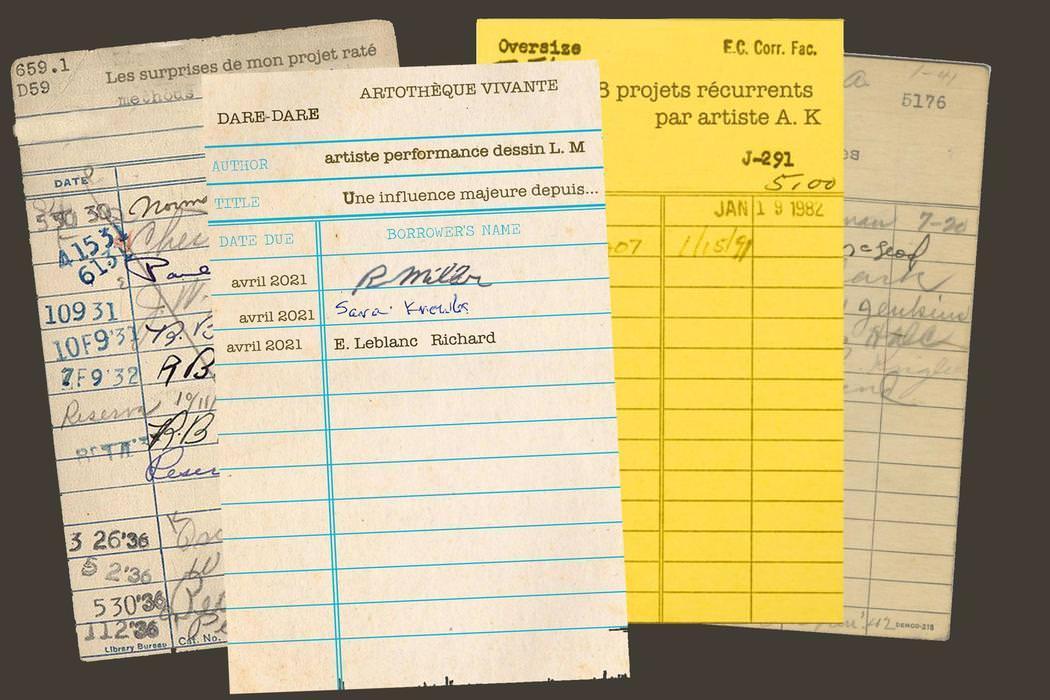
An idea of Espace Critique committee
Libraries are places of lush where books, people and ideas transact and transform through spatial and temporal encounters. New tracks are being dug in people's minds and intimate notes are deposited on the margins that come to life. This spring, DARE-DARE is offering its community a loan program bringing together a hybrid collection of stories made up of actions and words by : Amélie Brindamour, María Ezcurra, Melza Harvey, Emmanuelle Jacques, Mélissa Longpré, Noémie Sauvageau and Roberto Santaguida.
Our living library opens its doors for a maximum of twenty lucky borrowers who are able to intimately experience the story of artists ready to open up. Imbued with kindness and listening, these living books take the form of urban explorations, discussions, or even games, in order to encourage unusual and unforeseeable encounters and experiences.
The loans were based on a deliberately poetic, metaphorical, and elliptical description of an experience to be shared. This approach favored evocation over identification, allowing space for imagination and projection. Participants engaged in the experience without directly knowing the artist behind the concept or the central figure around which this universe unfolded, discovering the work/the artist through shared time and the attention given to the relationship itself. The loans took place between April 17 and May 10, with each lasting between 45 minutes and 1 hour 30 minutes.
Borrowing list
1
Title of the living book : Ce qui brille par son absence
Language of the book : Français
Description : Échange sur la proximité avec soi-même pour en souligner les fertilités et les difficultés. Mise en lumière de l’existence de deux solitudes : celle choisie et celle forcée.
Type of reader : Personne seule (emprunteur.ice unique à chaque rencontre)
Type of reading : Assise-dans un parc - ou intérieure (selon les possibilités et types d’espaces. À déterminer)
2
Title of the living book : Récit sur ma vie d’artiste, ou comment le Réalisme magique s’invite involontairement dans ma pratique.
Language of the book : Français, English, Español
Description : Un condensé d’histoires incroyables, en ce début de printemps tardif, où des épopées dignes de l’Odyssée sont entreprises dans le seul but de réaliser des visions artistiques.
Type of reader : Personne seule ou deux (maximum)
Type of reading : Marche-déambulation, assis-dans un parc, au téléphone ou en téléconférence
3
Title of the living book : Création de richesse/Labour of Love
Language of the book : Français, English, Español
Description : Ce livre d'artiste aborde des enjeux à l'intersection de la pratique artistique, l'économie, la parentalité et le travail invisible. Sa diffusion par une démarche relationnelle fait l'expérience d'une économie non marchande.
Type of reader : Personne seule ou Bulle familiale
Type of reading : Marche-déambulation ou assis-dans un parc ou intérieure avec masques et distance physique
4
Title of the living book : La Collectionneuse
Language of the book : Français
Description : Excursion urbaine sur le Plateau Mont-Royal. Au programme : observation d’oiseaux, prises de vue diverses, collecte d’objets insolites et recherche de livres usagés dans les bibliothèques de rues.
Type of reader : Personne seule
Type of reading : Marche-déambulation
5
Title of the living book : The Externalized Internal Dialogue Demonstration
Language of the book : English
Description : An interactive live story-telling experience. A ceramic artist vocalizes the memories, urges, whims, and judgements that occur during the creative process. Connection will be encouraged through sharing of both clay and stories.
Type of reader : Single person -a unique borrower at each meeting (for compliance with distancing regulations).
Type of reading: Indoor, shared studio space
6
Title of the living book : The First Phases
Language of the book: English
Description : A point-and-click adventure with a faculty time machine and other games.
Type of reader : Unique borrower at each meeting
Type of reading : indoor (online)
7
Title of the living book : Masked book / Libro enmascarado
Language of the book : English, Español
Description : This creative exchange involves wearing and/or making masks to explore, give visibility and embody the conflict between the need of protection and our veiled sense of identity in the pandemic.
Type of reader : single person or Family bubble
Type of reading : Sitting-in a park or indoor or online if someone feels uncomfortable meeting in person.

Amélie Brindamour
My artistic practice takes the form of temporary interventions, participatory performances, Eat Art projects, and photography, and explores a range of issues related to natural and urban environments. Favouring the use of affordable, easily accessible materials such as pine wood, cardboard, paper, and bread, my more recent projects seek to recreate spaces within nature and the city through the design of simple props, in order to challenge our perceptions of pre-established social and spatial systems. My interest in food has led me to develop several participatory performances in public space, involving actions such as baking and sharing bread. A staple food in most societies, bread evokes values of sharing and social justice while fostering conviviality, making it a particularly evocative medium through which to convey ideas. I support artistic and educational initiatives that have a positive impact or help build communities, as well as contexts that encourage collaboration, inclusion, and experimentation.

Emmanuelle Jacques
Emmanuelle Jacques lives and works in Montreal. She completed a Bachelor’s degree in Visual Arts at Université du Québec à Montréal in 2004. Rooted in drawing and print-based practices, her work brings together writing and relational art. Her practice is presented primarily in the form of artist’s books and installations, and occasionally through other media such as performance, video, or sound art. Across her various projects, she has explored topics including cartography, urbanism, feminist, punk, and DIY movements, economics, invisible labour, self-management, care practices, plants, stars, interstices, indiscipline, and utopias. Grounded in specific or hyperlocal issues, and working in the manner of a field sociologist—while retaining the methodological freedom of an artist—she creates spaces of encounter that foster the emergence of micro-narratives from which a shared meaning is drawn. Her slow, process-based working methods are directly inherited from printmaking traditions, as well as from her experiences as a forestry and agricultural worker.
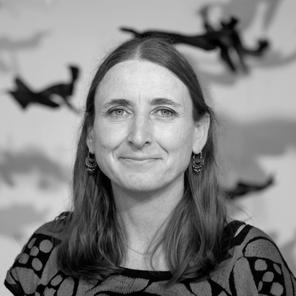
María Ezcurra

Mélissa Longpré
My artistic practice is largely inspired by the natural sciences and at times borrows their codes. Each project begins with a period of observation and the gathering of natural elements. Working in the manner of a naturalist, I collect, identify, and document my findings. Through photography, drawing, printed images, and installations, I translate my sensorial relationship to the living world. I explore the interweaving of art and science and the dialogues they generate. During my excursions, I photograph, sketch, take notes, and collect specimens (bones, insects, plants, rocks). Back in the studio, I create compositions in which each element becomes a particle of a new language. These specimens and found objects form an alphabet of the traversed territory. On my worktable, they become photographic subjects, visual writings, and installative objects. I am interested in the encounters that emerge through the sharing of knowledge.

Melza Harvey
Melza Harvey is an interdisciplinary artist born in Nova Scotia and based in Tiohtià:ke/Montréal. Coming from a background in mental health, where clay sculpture first served as a creative outlet, Melza went on to study ceramics at the Centre de céramique Bonsecours and at Concordia University, earning a Bachelor’s degree with distinction. Rooted in a feminist perspective, their contemporary sculptural practice uses abstraction to examine the social constructs shaping contemporary life, including motherhood, gender fluidity, queerness, sensuality, and anti-racist resistance. Working with high-fire clay through hand-building and wheel-throwing techniques, Melza pushes the boundaries of traditional ceramic practices to create organic, precariously balanced forms layered with colour and texture, where light circulates through and activates space. Social engagement is central to their approach, which also incorporates sound, interactivity, and community participation through collective ceramic initiatives focused on education, awareness, and social connection.

Noémie Sauvageau
Born in the forests of northern Abitibi and now based in Montréal, Noémie Sauvageau cultivates a deep love for the living in all its forms. Shaped by a diverse path spanning teaching, accompaniment, creation, and research, her practice is grounded in a sensitive understanding of our interconnections, vulnerabilities, and the subtle forces that bind us to nature. Trained in philosophy and comparative literature, she approaches thinking as an embodied, porous gesture rooted in a hypersensitive relationship to the world. Her artistic practice is first and foremost a way of inhabiting the world. Poetry, experimentation, and play become tools for interaction and understanding. She views play as a form of gentle resistance—an open space of discovery where one learns to engage in dialogue with the living rather than to constrain or dominate it. Through audio-digital projects, creative expression workshops, performances, and collaborative research, she explores modes of existence that privilege slowness, presence, resonance, and attentiveness to the discreet forces that move through us. Rooted in the sensorial, her approach invites us to relearn the world through care, listening, and relation.

Roberto Santaguida
Since completing his studies in film production at Concordia University, Roberto Santaguida’s films and videos have been shown at more than 400 international festivals, including Tampere Film Festival, CPH: DOX, Copenhagen International Documentary Film Festival, Contemporary Art Festival Sesc_Videobrasil, Flickers' Rhode Island International Film Festival, Transmediale, and Message to Man. He has also taken part in artist residencies in numerous countries, including Iran, Romania, Germany, Norway, and Australia. Roberto is the recipient of the K.M. Hunter Artist Award, the Chalmers Arts Fellowship and a fellowship from Akademie Schloss Solitude in Germany.